Didn’t God Know Lucifer Would Turn Evil? Why Did He Create Him?
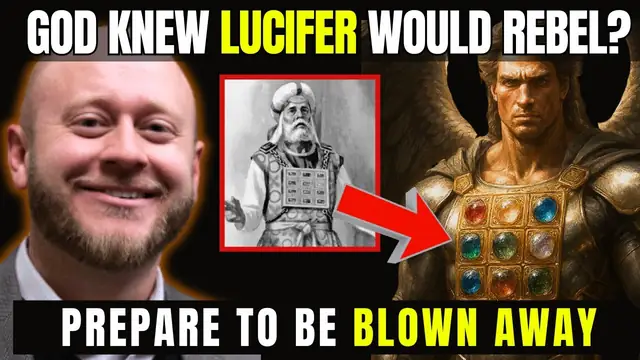
If God knows the future, why did He create the being who became Satan? In this conversation I put that question to theologian Professor John Peckham.
He starts by saying evil did not catch God by surprise, then walks through foreknowledge and free will, God’s love and patience, and Jesus’ parable of the wheat and the weeds, where “an enemy has done this.” The answer points to a cosmic conflict about God’s character, not a gap in His knowledge.
Key moments
- 0:00 Foreknowledge and free will
- 2:02 Divine love and longsuffering
- 4:02 Parable of the wheat and weeds
- 6:20 The role of the antagonist
- 8:01 Cosmic conflict of character
Read the transcript
Auto-generated from YouTube captions and lightly cleaned, so it may contain errors.
0:00 My question is for the professor. Um, if God is omnisient, how come you didn't have the perspacity to know that Lucifer would become the devil and not create him? Yeah, it's a great question. And so, the first thing I would want to say is that evil did not catch God by surprise. So, he didn't know beforehand. The Bible does describe that he he has fornowledge. So, he knows the future free will decisions of creatures before they take place. So, why didn't he use that fornowledge? Many people ask, and I think this is what you're asking. like he he could have just not created uh the creature who fell and became Satan, right? Why doesn't he just use that power to not create him? And there's more than one possible way to answer that question. I don't claim to know. I'm certainly not God. I don't claim to know what the answer is, but there's at least two possible solutions. I don't know what if either one of them is correct. Uh but one of them is that perhaps if God were to use his fornowledge and say, "Well, I'm just not going to create Lucifer uh because he's going to do all these horrible things." It might be that someone else would have arisen that would be even worse, right? It might have been worse on the whole for the entire universe if God had used his fornowledge in that way in ways that we cannot actually understand or foresee because we don't know the end from the beginning. But then you can say, well, why doesn't why wouldn't God just use his fornowledge each time, right? Anytime someone might sin or do evil, he just doesn't create that individual, that angel or that creature. And it seems to many people, many thinkers, that if God were to use his power that way, that none of us would really have free will. We would just think that we did. We would feel as if we did. But actually, no one would ever actually have the power to exercise their free will to act in any way other than the way God wants them to because he's already taken it away preemptively. Even if we didn't know it, he would know it.
1:43 And if God is really love and going to grant genuine freedom, it seems like he can't use his fornowledge in that way to stop someone from coming into existence just because he knows they're going to misuse their free will. Uh those are a couple of ways that people approach the question. Again, I I don't claim to know, only God knows, but those are some ways of thinking about it. Dr. Dr. Beckham, when you read scripture, there are indications that God doesn't always upon his fornowledge of of events or situations or decisions, right? He he acts in in very principled way with the almost as if he is wanting to give that individual the most amount of opportunities to do what's right, to be saved. I mean, you can read example of of him working with Judas. He had an understanding of who Judas was, but he gave Judas every incentive to do what's right. Yes. And and that's really fascinating because I I think that that is really helping us to understand that when the Bible says God is love, he truly is love. I was thinking of that exact same example of Judas that Jesus already knows the character of Judas, right? Have I not chosen you? But one of you is going to betray me, right? He knew what was going to happen. Uh but he but but God Jesus in the gospels and God more broadly in scripture uh he takes the long view, right? And so you have one of my favorite verses in second Peter 3 tells us that God is toward evil. And why? Because he doesn't want anyone to perish. So it says God is not slow about his promises, right? But he is long-suffering because he doesn't want anyone to perish, but for as many as possible to have the opportunity to come to repentance. So God is acting in a way to bring about the greatest good in spite of all the evil in the world in ways that don't always make sense to us.
3:36 But if we could see and know everything he knows, all of these factors behind the scenes, including unseen factors, right, in in in with demons and angels and all kinds of factors that the Bible sometimes brings to view, but we typically don't see around us, then we would understand why God acts the way he does at times, uh, and why he refrains from acting in ways that we might think that he should. But he has very good reasons uh, for acting as he does. It's it's fascinating when you read the book of Job, you obviously read about this dialogue between God and Job, uh God and Satan and and Job gets thrown into the midst of it and when all this tragedy happens to Job, when Job talks to God, the idea of Satan and the devil is never even brought up. That's right. That's right. And that's really fascinating. There were just some things that Job was not privy to. But to the reader, the curtains are drawn back and say, "Look, there's more than meets the eye here." Could you help us develop a little bit more and understand a little bit more of this of this framework of how we are to truly understand life? Well, Jesus tells a parable in Matthew 13. He tells a parable of a landowner who swed good seed in his field. But then while he was sleeping, an enemy came in and swed noxious weeds in that field and they sprang up and they grew together for a time. And later the the the servants of this landowner, they come to him and they say, "Sir, didn't you sow good seed in your field? Why then does it have all these weeds?" Which is the same kind of a question that people ask of God today, right? Didn't God create a good world?
5:11 And if he did, then why is there evil in it? Right? His answer was, "An enemy has done this. An enemy has done this." And then his servants ask him the follow-up question. and they say, "Okay, well then then then why don't we just go and pull the weeds up? Just get rid of evil." Right? The same kind of question people ask today. Okay, so so there's an enemy of God. Someone has misused their freedom to do evil, but why doesn't God just go and and eliminate it? Pull it up. And the answer again is profound. He says, "No, because if you prematurely uproot the weeds, they're entangled with the wheat. And so by pulling it up prematurely, you might actually uproot some of the wheat. In other words, for some reason that we don't always understand for God to prematurely root out evil would actually do more harm than good in the short term. Wow. Now, when Jesus tells his his disciples, explains this parable, he makes it very clear that he's the landowner, but the enemy that swed those seeds is the devil. So something much more is going on. what we call a cosmic conflict or a conflict between good and evil in this world that we often don't see. Okay. The way you're setting us up is look, there is a a a God who is love. He values freedom of choice. That is very important to him because without freedom of choice, love just doesn't exist. It cannot exist.
6:34 You let us know that there are decisions that are made here and and those decisions could not be or cannot be stopped or should not be stopped often times because if God was to do so there would actually not be choice that exists. But then you're letting us also know look there's an antagonist. Yes. In our world. Could you flush that out a little bit more for us? The concept of a devil. Is it just this leotardw wearing uh yoga pantwearing uh demon looking uh devil with the pitchfork? Could you tell us a little bit more what does the Bible actually say about this antagonist? Yes. Yes. So the concept that many people have of the devil is is is really a mistaken concept. They have this kind of caricature, a cartoonish figure, right? But the Bible describes the devil as originally created as an angel of light, created perfectly good by God, but misuse his freedom to rebel against God and against love and and fall from that station. And he is described later in the New Testament. Jesus himself describes him as the ruler of this world, which means he has some real and significant jurisdiction in this world temporarily. Wait a minute. God is all powerful. There's no one more powerful than God. That's what makes him God. And then you you got an angel, a fallen There's no power struggle here. God is obviously the champ here. That's right.
7:57 Could you break that break this down a little bit more for us then to understand this tension then? That's right. So if it was a if it was a conflict or a struggle of sheer power, there could be no conflict. God is all powerful. Right. So the conflict must be of another kind. It's actually a conflict over character. And if you were to look at the Bible story from beginning to end, you see that from the beginning to end, the devil is a deceiver. He's a liar. Jesus calls him the father of lies and a murderer from the beginning. And from the very beginning of the story to the end, he slanders God's character. So he can't dethrone God by force. He doesn't have the power to do so. But what he tries to do is undermine God's authority in a universe of free beings by causing people to question God's goodness, to question God's love, to question God's law. And that kind of those kinds of allegations. Not only uh are they allegations that can be lodged by someone less powerful. Uh they also can't be answered by a show of power. Right. Which is what we all want. That's what we want. We want God to step in and just put an end to evil immediately to stop this bad guy. That's right. So, so if you imagine uh like a mayor of a town who's accused of corruption, they're falsely accused of corruption, right? They're not corrupt. But if they were then to use all of their power to squash the allegations and squash the people raising the allegations, would that clear their name or make the problem worse? Make the problem worse. Actually make the problem worse. Unless first there was some demonstration of their innocence or demonstration of their goodness or demonstration of their character. And that's what we see playing out in this world. a demonstration that the the the devil's allegations are false and that God is truly good. Not for God's sake, but for the sake of the entire universe because the only way the universe can flourish is if everyone uh trusts God unreservedly and trusts his goodness unreservedly. So God is not doing it for himself. He's all powerful. He doesn't have to defend his name. He's doing it for the sake of love. If you think your beloved is a tyrant or you think your beloved is is really evil and not really good, unless those kinds of misgivings or doubts are cleared, there cannot be a
10:00 True genuine full love relationship of the kind that the entire harmony of the universe is based on. Dr. Beckham, as you've set up this amazing clarification
More on this question: Why is there evil, and is Satan real?