Ancient China’s Lost Connection to Genesis
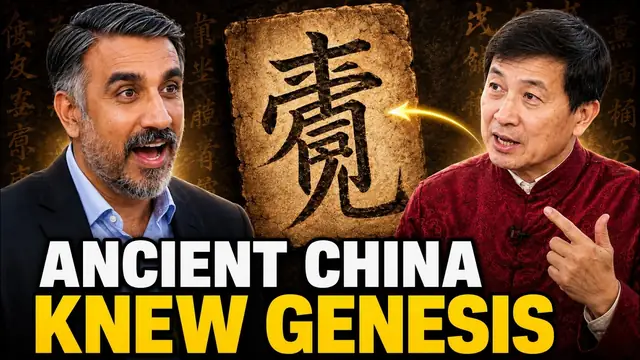
Is the Genesis story found far beyond the Middle East? On Hope@Night, Chinese scholar Dr. Samuel Wang and physician-researcher Dr. Tim Riesenberger look at ancient Chinese characters that seem to echo creation, the Fall, sacrifice, judgment and redemption.
One example: the character for “righteousness” pictures a lamb over “me,” with a hand holding a spear, much like the Hebrew sacrifices. We finish with audience questions on the cultural impact.
Key moments
Read the transcript
Auto-generated from YouTube captions and lightly cleaned, so it may contain errors.
0:00 When you look at me, the character for me in righteousness, ye, it's the lamb over me, but me is actually hand and lance or spear. And so literally what the character is, my hand takes the lance, kills the lamb, and the lamb covers me. That is exactly what the Hebrews did. The person who was confessing their sins had to bring the lamb, they had to kill it, and their blood, the blood of the lamb, had to cover that person's >> And what Dr. Wang mentioned earlier, I mean, when you look at the sacrifices of the Old Testament, they were not unclean animals. They were clean animals that you mentioned, the bull, the lamb, and that's exactly what was being practiced, you know, by by some of these emperors of of time past. >> Dr. Wang, thanks so much for being here. >> My pleasure. >> When did you realize that there was a link between Chinese characters and Bible stories? >> You know, born in China and then we study Chinese writings, I never really thought about it, any connection between the writings because we use it every day, until I got to the graduate school and uh we have a linguistic teacher teaching social linguistics. Every time when he closed, before he closed the class, he would show a character, then it's the link to the That opened my mind. That was the first time, first exposure I ever had. Wow, that is in the in our writing?
1:29 Never thought about that. >> So you started seeing these sort of references to Bible stories in the Chinese language? >> Cuz he was showing a few, you know, one word at a time, showing like this is a the garden, and then in in the garden you have uh four rivers, just like in the garden of Eden you have four rivers going to different four directions. Then you have a man, there's a garden that is someone to working there, and that's the the Chinese writing for man. He said, "Huh, how how would that happen? You know, all of this correspond to what the >> So, what's so unique about the Chinese >> Well, there First of all, this is uh probably the only ancient writing systems that's still being in use today. We got a quite a few ancient writing systems like Sumerian, like the Maya, and like Egyptian. >> How many are there? >> Uh normally we say there are five of them, but today there's only one that is being widely used. The others are only known to probably a handful of scholars only. And even the scholars maybe only know um very minimal. But the Chinese predates the Bible. Remember this, the Chinese writings predates the Bible. We didn't get anything from the Bible. We had it before the Bible was written.
2:47 So, in other words, when God gave revelation, even before the writing was invented, it was all through the word of So, by the oral revelation, and his revelation was given to humanity, but among all the ancient civilizations, there's only one civilization has the unbroken chain of history. That is the Chinese history. And so, we we got to just link to the very ancient oral revelation period. That's why we have it. >> What role do Chinese characters play in the transmission of culture? >> That's a very good question, because like in in English, you would add new words. I mean, your dictionary getting bigger and bigger, millions of words. the Chinese language, the writing remains about the same from the beginning to now. So, today I can still read the same script like 4,000 years And we have different dialects. Uh I'm thousands of dialects. I mean, personally I speak over 20 styles >> You speak 20 over 20 dialects? >> But well, there's small differences. It's it But this thing is we write the same way. Our writing is the same like Cantonese, you heard about the Cantonese, they're different from the Mandarin. But hey, when we write, the same.
4:12 So So the Chinese writing play a role a role that cannot be replaced because it kept the stability of this culture because the character does not change. The thoughts, the teachings in the very ancient time through the characters come down and pass it down to the later >> So how old is this this this language >> Well, we we normally say 5,000. That's a not a real number, but it means more than 4,000 years. Now there if you look at the Bible and we do a chronology then you will see now today we've got the you know, Jesus ascension at 31 AD. So all those dates, how did you get it? That is because you put creation at 4004 BC. That's where things all things So then after 1656 years, then you have the the the flood. And then 101 years later, then you have the Tower of Babel. Now all of the people spoke the same language at the time. But after the Tower of Babel, people were scattered and then you have different languages. >> So the Bible tells us at the Tower of Babel that um when this thing was brought down, that there was this dispersion of cultural groups that were separated by languages.
5:32 >> Right. They the the language is confounded and so So you can see now the the the Chinese is interesting in our chronology, the first written chronology is 2205 BC. Which is only 42 years after the Tower of Babel. >> That's fascinating because from the Tower of Babel, what happened before was the flood. So, it would make sense that these cultures would be taking with them recent history. You know, for example, I grew up in the Hindu culture and prior to me becoming a Christian, I had learned about a worldwide flood. That was in the Hindu culture and I know this is prevalent in other cultures as And but you're telling us that these stories these this sort of this recent history of creation and then the flood, Tower of Babel, that this was actually built into the Chinese language >> Because we were the ancestors of the Chinese were exposed to the oral revelation in that era. I mean, especially after the the flood. After the flood in the Bible, it says that only eight people survived. We have a character that say it is a boat eight people in it in a boat. So, that's the Chinese character for a boat. So, >> if you look at the Chinese character for >> eight people in it.
6:50 >> It It is actually composed of >> a boat >> eight person eight mouths one mouth representing one person. So, you got eight mouths in a boat together. So, that is just showing us we are connected with that. >> Could you give us some more examples of this cuz that's really fascinating. >> Oh, yes. You know, if you look about the ancient times, what what are ancient times are we talking about? Well, the early ancient time was washed away by the flood. So, the next the ancient time where the we our current civilization is connected, it would be after the flood. So, the in the Chinese writing, you have the word for ancient. Then you have the The days of the waves. Now, that was evidently it's about the flood. That is the only time you got the ancient. So, these are the some of the words we have and then the Chinese history started. You know, the Noah's family survived another few hundred years even after the Tower of Babel. So, possibly one of them come to China or is it descended come to China? In the whole world, all the language today you're basically all phonetic spelling except the Chinese. This is the only language the only writing system. Now, even the linguistics I am a major in linguistics You study about the language. You don't study about the writings normally.
8:13 Because there's not much there into the writings, but not so. With the Chinese writings, you get all the oral revelation. Everything you can find in the Bible is in our writing system. >> Okay, Samuel, I need you to convince me some more though. I need more examples. You got me interested and you got my curiosity sparked on this, but I need some more examples on this. >> Let me just show a few examples. The first one I'm going to show you is about the value. I mean, we all live we have a value system. It's kind of a shows our morals, shows how we behave. So, what is your value system? Now, you will if you look at the Chinese characters, this is a word for value. And then you have a person right there. And then you have a man of integrity. Value means the only valuable thing is teaching through this word is to us that a man of integrity is the only valuable thing you should So, that is definitely it's biblical. And the Bible teaches the same thing. >> Well, it sounds like these It sounds like what you're telling us is this this ancient wisdom that's found we see clarified in scripture and that was, you know, previously carried through oral transmission that these these truths of of living upright, of of following God, even the story of the flood is just literally built in staked right into the very language itself. Is other parts of the creation story in the Chinese >> Oh, yeah, there uh for instance, you have all the basically all the Eden stories like I give you one example. I mean don't talk too much about a man, let's talk about women.
9:49 The creation of women is the last piece of all the creation. So when the woman was created everything is settled. Everything is ready. So in the Chinese character we have one word means ready. And that character you have a three fingers indicating God the Father, the Son, and Holy Ghost. And then in making a a woman and that word is settled. Everything is ready. So you have a woman there. And then God put the two of them in Garden of Eden. Now we have I mean in English you call that a uterus or womb, but in the Chinese we have a much beautiful name. I'm sorry. It's >> We we call that the palace for the son. The You mean the children you have It's a palace for the children. So if you look at that word the palace there's only two person in it because in the Garden of Eden there's only two people in it. You know God said there's the two trees special trees you can eat from one don't touch the other >> the tree of knowledge and evil. >> But the woman ate the the the forbidden tree. The Chinese we have it one tree and two tree and a woman come under the two trees and that is the word for >> Now in the word for greed greedy you don't have a man there.
11:10 Man today are many men are very greedy. But the first one to be greedy the Chinese recorded it was a woman. >> So there's a woman under a tree? >> The two under the two trees. >> She faced you know she's back he's against the one tree that's according to the Bible when they were chased out you know that's the tree of uh a of life. So she facing the other tree uh to the west. That's the tree of knowledge and good and evil. >> That's really fascinating that you see a lot of these references to the the biblical story. How about the the plan of redemption? Is that in Is that in these characters? >> in Now, when God gave the the command, he's not simply telling them um you know, don't eat, but he also tells them the consequences. So, in the Chinese characters I'm going to show you, you will have this only thing that you need to restrain yourself. I mean, you can do everything you want, but there's only one thing you should restrain yourself. That's in the Chinese character. That is you have a tree in the middle, and then you have a mouse in the middle of the tree. Don't the mouse don't touch the tree. That is the the word for restrain. Restrain yourself. But if you don't, then we have another word in the Chinese writings that said to die. Die in the middle, you still see a tree, and then you see the two hands and two mouths there, and that is the word to die.
12:35 So, but that's not the end of the story. God didn't leave man end there. And that otherwise we wouldn't be here today. He have a plan of salvation even before we were Now, you say, "How is that? That could be couldn't be possible." I just think about a human wisdom. A building like this, you have a You have you know, you have the firefight uh what is uh extinguisher, you have a hose. All of this prepared. You may never use it. You better never use it. But it still needs to be there. Even for humans, we know how to design for emergency. You drive a car, you have a airbag. It's hidden. You better never see the the airbag. You'll be okay. If you saw it, then maybe too late. So, even before God creates us, he already have all the plan in case things go bad. What to do? So, he got another plan that is that we have a character not a a lot of words, but just one word to show the whole plan of salvation. There is uh a great man. And then there is a fallen man a man falling down. And the great man come to help this fallen man the bring him back. That word in the Chinese we call the shin. Shin in the Chinese is you are supposed to die in this accident, but you survived. That is called the shin. Or you don't deserve it, but you receive it. That's called the shin. It's unexpected grace, unexpected blessing. Now, you look at the picture. Everyone can see a great man standing man and another man disobedient man fallen man. And this man come down from heaven come to help him.
14:14 That is the whole plan of salvation. Just right there. >> Dr. Wang, as you've you know, understood more and more about the plan of redemption, is there more of that also in the Chinese language? Are there other references to the great plan of redemption cuz that is the theme of scripture. Is that in the Chinese language also? >> Especially there's this central figure is Jesus. And Jesus is called the son of Now, the Chinese writing system the word for the word the character it means the story about the son. We have the word a son in it. Just like in English you have his story, but in the Chinese we have is all about the son, the son of a heaven. Now, we have two words like you know, when man fell into sin God said a the savior would be called the seed of the So, we have many words connected about the seed of the woman. For instance, maybe many of you have heard about the ni hao. Anyone you know? So, the word hao hao means the seed of the woman. You have the woman and then you have a seed. The two put together means hao. So, in this word is telling us the only good thing for this world or the only hope for this world, bring hope to this world, is a seed of the woman. So, we have this word in the Chinese. >> Wang, let me ask you a question. Um and I know within China currently that there are different kinds of, you know, you got Buddhism and some other flavors of Buddhism and then you got this kind of atheism too that's there. But if you were to look throughout Chinese history, you know, you talk about oral revelation, you talk about a group of people that probably separated from the Tower of Babel and then headed that direction which eventually became of, you know, the uh China.
15:58 Do we see any part within Chinese history where some of these biblical ideas were part of the religious beliefs of the culture at that time? >> Basically all throughout Chinese history until 1910. There's always a worship of heaven. The greatest ceremony in the Chinese is called the sacrifice to heaven. If you go to Beijing today, there is a Temple of Heaven there. That building has been there for 600 years. That is a place that Chinese worship heaven and give sacrifice. Now, you got to be the the emperor, the king to make the sacrifice. Cannot be any other one. Now, people think, "Well, it's only in the Bible talk about the day of atonement." That's a little bit, you know, once a year. That has been kept in China for more than 4,000 years. We have that until in the recent history when the British came in with the Opiums. >> So, you're telling me that at least historically within the Chinese history that there would be um the king would offer a sacrifice to heaven? >> Once a year. >> Um what was the purpose of that sacrifice? What was being sacrificed? >> It's a bull. A perfect bull. Actually, if you look at the Chinese characters, it says a The bull or a lamb would be sacrificed.
17:19 >> That's like the Hebrew culture of >> only thing is we predate what whatever the people come up. They are the younger brother. We are a little older brother, you know? So, because we bear but however, the Chinese record the bear the extra biblical evidence to tell the same story and what the Bible says. So, actually provide a further evidence to support the Hebrew Bible. It's not a made up because the Chinese even before Moses was born has already written up. It is the same. So, the two sources telling the same stories about the plan of salvation, about our future, about our life does not come from us. It's all everything come from God. >> And it's beautiful because it truly teaches us what Jesus said when he said, "I am the of the world." That all places, at all times, light from heaven was always shining about the sacrifice that God would make on behalf of humanity. And that's what's so beautiful. Dr. Wong, thanks so much for sharing. Again, we have much more to talk about. We've learned how the story of Genesis was embedded into Chinese history and characters. It's amazing to see how God has been speaking to humanity in so many ways, pointing us to the hope and redemption found in him.
18:38 After the break, we have a doctor whose life was transformed by these very characters. Don't go away. >> Welcome back to Hope at Night. We've just heard from Samuel Wong how traditional Chinese characters, still used today, carry stories of Genesis, Eden, and even the plan of redemption. Our next guest has studied both medicine and Chinese characters. Please welcome to Open at Night, Dr. Tim Riesenberg. Now, have you been listening to this amazing interaction between, you know, Dr. Wong and myself about Chinese >> It's unbelievable. Uh my mind is just >> Now, what's your interest with these Chinese characters? How in the world did this impact you? >> I actually grew up in a Buddhist and Catholic home. My mother was born in Shanghai, China. However, my entire family had to flee from mainland China to Taiwan. Now, the reason for that is that my great uncle, through marriage, was Chiang Kai-shek, the democratic leader of China. And I found this out later on in my life, and as my mom kind of shared this legacy of our family, it was very, very life-impacting. And I didn't really study a lot of Chinese. I'm kind of like a banana, you know? I'm uh I'm white yellow on the outside, but white on the inside.
20:15 >> last name is not a traditional Chinese last name. >> cuz I'm half German. That's the Catholic side from my dad. And so, basically, I began to kind of get more interest in this beyond the red envelope, beyond the mooncakes, and things like that. But the real epitome happened was when a friend of mine who was a linguist sent me the character for righteousness, yi. And when I looked at yi, I began just weeping and weeping as I saw the gospel. And I even checked it on Google Translate. Traditional Chinese characters, righteousness, and I saw a picture of God that absolutely transformed who I was, not only as a doctor, but as an individual. >> Well, don't keep it to yourself. What did you see actually in that that that free that righteousness? >> In that character, it kind of is like when I was sharing on a flight to Taiwan. I was on a flight to Taiwan to do some recording to actually talk about this discovery. And I sat next to a young woman about your age. And she's like, "Oh, I love the traditional characters. Show me one. Show me one." And I said, "Draw righteousness." And she draws it, right? And I saw, "Draw lamb." She draws lamb. "Draw me." She draws me. But what's interesting is I told her, I said, "Now put lamb over me." And she's like, "Huh?" I said, "Take the character, squish it on top of it, and what do you have?" And she's like, "Well, you have righteousness." >> Dr. Wang, is he telling the truth right >> Oh, yes. This is really amazing. You know, we have a another word can support this very well. Even like we say America, we say meiguo. It's a beautiful country. It's a word for beauty. There's also a big lamb. Now, there's also so many animals that are very beautiful.
21:54 Why a big lamb is beautiful? So, that is all connected because it's a lamb of God that is sent down to take away all of our sins. >> When you look at me, the character for me in righteousness, yeah, it's the lamb over me. But me is actually hand and lance or spear. And so, literally what the character is, my hand takes the lance, kills the lamb, and the lamb covers me. That is exactly what the Hebrews did. The person who is confessing their sins had to bring the lamb. They had to kill it. And their blood, the blood of the lamb, had to cover that person's sin. >> And what Dr. Wang mentioned earlier, I mean, when you look at the sacrifices of the Old Testament, they were not unclean animals. They were clean animals that you mentioned, the bull, the lamb. And that's exactly what was being practiced, you know, by by some of these emperors of of time past. >> You know, Dr. Tim, as you were studying out these Chinese characters, what did you understand about their age and their continuous use? >> I think the amazing thing for me is I've actually seen the Dead Sea Scrolls. and when I came to understand that these traditional characters were in place almost a thousand years before the earliest manuscripts of the Bible itself, I realized whoa, wait a minute.
23:13 This was almost a millennia before, and the Chinese characters have not only been old, but as Dr. Wang has already implied, they have been continuously used. They're not a dead language. I don't have to talk to some expert. I can talk to someone from Taiwan or Hong Kong and say, "Hey, what does this character mean? What does this part of that character mean?" And they will be able to tell you. >> You know, this is fascinating because some people will say simply because of the dating of the Bible's writings that there are older, let's say, Eastern religious texts like Hinduism that predate that. But, the truth of the matter is the biblical religion outdates, you know, predates well before any any other creation of any of these religious systems. You know, it's it's amazing. I was actually studying out a research project a number of years ago about this Well, this researcher spent some time with the Pygmy people in the in the very heart of Africa, the Congo And as he was spending time with them, you know, he began to find out that they had very much a creation story, a fall story, and a flood story that paralleled very close to the Bible >> And and you find this all over the world. And it's not just sort of this, you know, sort of sociological natural part of history, this is what everyone thinks. But, really what we're finding in scripture is the most accurate depiction of what took place in history, and then what broke away in these various cultures where they carried the information as far as they could as far as they could accurately last. You know, are there other characters that stand out to you in the Chinese language that that speak of Bible stories and biblical >> Yes, absolutely. I always thought, you know, the Chinese were atheists. Before that, they were Buddhist. I really thought nothing else until I started delving into this. And of course, the character righteousness brought me along that. I looked at spirits. Now, in Chinese, there's a good spirit, ling, and there's an evil spirit, gui. So,
25:16 They're they're different. But the good spirit is such a complex character. The good spirit in Chinese is the one over the waters in three persons that can do anything or work magic or something like that. Now, that's a funny thing because in Genesis 2, we find that. The spirit of God was hovering over the waters. Then God said, "Let us make man in our own image." Now, the interesting thing is in an English, us is two people, right? Or it could be 500 people. Same thing in Spanish, uh nosotros puede ser dos o puede ser quinientos. Nosotros is the word for us in Spanish. It could mean two or could mean 500 is what I just said in Spanish. But in Chinese, is three. Mhm. And that's incredible because of course, you see the Trinity. You see uh many places in the Bible, when Jesus was baptized, right? The Holy Spirit was descending in a form like a dove, and then the Father said, "This is my beloved son, in whom I'm well pleased." You have the Trinity there. There's many places in the Bible you see that. But in the Chinese, the Trinity was there before the Bible was ever written. >> Wow, that's fascinating. Share with us some more. I want to hear more about >> Yeah, there's there's another character that's very intriguing. Um many people would think that the character for happiness might be just like a smiley face or something like that, but it's not. The word for happiness is fu. And we're not talking about egg fu young, okay? We're talking about true happiness. We're talking about the real meaning of life. When you look at happiness, it's not cars, it's not family even, It's not houses, it's not lands, there's no money, but it's you with God in the garden or or nature. And the interesting thing is that little box character can be a speaker or a mouth.
27:05 Obviously, you see one is just one dash, and then the garden is as Dr. Wong alluded to, a place with the four lines coming out of it, the the four rivers. But, I thought to myself, what kind of definition for happiness is this? And I began studying different other writings, and I found a definition for happiness in an in a book that was actually written about 5,000 years after the Chinese characters. And it's a book called Patriarchs and Prophets. It says, "Happiness is not found in indulgence of luxury, but in communion with God in nature." So, I saw that same character coming out, and I'm like, "That is crazy. I got to study this out more." >> Who wrote that book? >> That was actually Ellen White. And I'm just like, I started reviewing her, and I'm like, "What's Who's this person?" She had like a third grade education. She was like in the 1800s. And I'm like, "But, where did she get an insight from Chinese?" That's basically the same definition there. >> And she's the author of the book you mentioned the Great Controversy in a previous episode about, you know, clarifying what what Bible truth is. It's fascinating. So, how about, you know, Dr. Wong actually mentioned earlier about the Garden of Eden temptation? Anything in that? >> Yes, absolutely. When you look at the character for evil spirit, it is gui, and gui is a very interesting character, like devil or something like that. And it is there is a secret man alive in the And that is exactly what the devil does in the Genesis account. He wasn't himself, he was hidden, right? He was secret, but he was alive there in the garden. And when you look at that temptation, the character for temptation would be more. And what's intriguing is devil is not just in the word for temptation, but the Chinese are so detailed. They tell you where it's going to be.
29:05 The devil will hide in the trees. And that's where the devil was restricted to. He was there in the tree. So, I'm like, how is this possible? This is like crazy. I'm like starting to see the parallels between a language that is older than pretty much any other language continuously you still use today and a connection with text that came a thousand years afterwards and then connection with text that came 5,000 years afterwards. And I, like Dr. Wong, made the same conclusion. How can all these be connected? I had an atheist come and he heard this presentation. And he came up with this idea. He was trying to poke holes with everything. And he says, "I've got the Moses was Chinese." >> And I was like, "Whoa, okay." Several thousand miles apart and thousand years apart. But it's like Dr. Wong said, "All of these are separate witnesses." And the Bible says, "Out of the mouth of two or three witnesses shall every word be established." We have two or three sources. An ancient source, the Chinese characters. A relatively more modern source, the Bible. But then recently these books, Patriarchs and Prophets, Great Controversy, same message, same definition. And that is what blew my >> Uh Dr. Tim, you know, I asked this question earlier of Dr. Wong, which is when you're looking back not just in Chinese, you know, language history, but also the culture and the practices, have you ever seen anything within Chinese history that is sort of a reference to, you know, the Hebrew system of maybe sacrifice or worship?
30:43 >> Absolutely. And when you look at the ancient Chinese emperors, they worshipped a monotheistic religion. They worshipped one God. And the word for God is a reference kind of to a lot of Genesis. Um we have the word we mentioned Ling already. We have Tian, which is the great one. We have Shen, the one that is revealed in the garden, and we have Shangdi, the heavenly emperor. And these emperors worshipped according to the actual Genesis account. >> You know, I always have a comparison. >> After Moses takes the people from for the 3 months and every day there's mana coming in and they didn't finally they come to Mount Sinai and they only 40 days they didn't see anything. They have a golden calf. They just start to worship a golden calf. There are the Chinese for more than 4,000 years they didn't see anything. No idols. So here you got 40 days idol worship. There's 4,000 years no idol worship when you come to sacrifice. You tell me who is a better people of God? >> The Chinese, I guess. >> You guys aren't biased at all, by the way. I want you guys to know that. >> a little bit. >> So Dr. Chan, I got to ask you though, what is this showing us about the plan of God for Chinese people, but not just Chinese people, but for the whole world?
32:02 >> I think what it's showing is that God has given us an example. And that is the character Young. Example. And that character is absolutely phenomenal. It is giving us an example of how to live. The word example is the lamb, we see that again, on the tree, but Jesus dies on uh the cross for our sins. And then the last character there is eternity, to bring back eternal life. God's purpose is to bring all people groups, Chinese, you know, Africans, Hispanics, Europeans, everybody, he wants them to know that God's example, Jesus, the sacrifice on the cross, is to bring back eternal life for all of us. And that is the thing that I would walk away with is that God is there, no matter what culture you're from, no matter what people group you're from, there has been light as you referenced, Anil, that is lighting every person that comes into the world, and God's light is eternal for each one of us. >> That's beautiful. Dr. Tim, Dr. Wong, thanks so much for this amazing uh dive into the Chinese language. I guess we can study that along with the Bible to understand more about the plan of redemption. That's incredible. How the ancient characters from China still point us back to the creator and his plan to save our world. When we come back, we'll take some questions from our audience. And remember, visit our website at where you can also download a free gift for this season. We'll be right back.
33:33 Don't go away. >> Welcome back to Hope at Night. Tonight, we've heard how ancient Chinese characters reveal the story of creation and redemption, and how God left traces of the gospel even in Chinese language. Now, it's your turn. Now, I've got to ask a question first. Does anyone here speak Chinese? Right over there. Can I ask you a question? Did you understand what was being said, and did you learn anything >> Did it make sense? >> Yes, I understand. I feel it's absolutely correct. Um I use Chinese every day, and I text my mom and friend in Chinese, but I not never thought they could be understood in this way. So, I feel this entire session is very >> Yeah, something new to think about, right? Do we have any questions from our audience? Right over there. >> Are you able to take the characters that make up a word, rearrange the characters, and create a new word or give the word a new meaning? >> Oh, yes. Um the In the Chinese, we have what do you call the radicals. And the modern writings, we have 212 radicals. But in ancient times, it was shorter. It's about 190. So, those these radicals can be combined in different ways to form new words. However, the creation of the invention of the Chinese words are different than in English. In English, you we see a new things, you have to invent a whole new word.
35:09 So, you got your vocabulary getting bigger and a bigger. No, we don't do that. In the Chinese, we use the We basically words, we have a different combinations of words, then we create a new phrase or new word. So, in this way, you'd only need to learn the basics, and then the endless new creations. But then also what you are asking, the radicals, different parts of it can be combined. By the way, never We actually don't increase new inventions of the characters, but different ways of using >> And what's powerful about what was said earlier in regards to these Chinese characters that have references to Bible stories is that those are from ancient history. These aren't just sort of modern, you know, reconstruction of the the Chinese language. We're looking at something that has been historically used throughout, yeah, throughout >> Yeah, I I first time I went to Taiwan, and they say this is a big lake, Sun Moon Lake. I mean, I come from China. I come from the place big land, big river, big lakes. I see that little lake, and they say this is the big one? Come on. So, for for the things when we come to the biblical studies, the biblical scholars think the biblical world is only in the Near East. I mean, that is too narrow-minded. The The world include all God's creation. That is a biblical view. However, the current studies only focus on the Near East culture and history, so they neglected I think they need to open their mind to see okay, the world is bigger than that and the biblical world actually include all the universe God created. That would have been the correct way of studying the >> So, let's let's go to the Old Testament of scripture.
36:50 Are there any references to China? >> Yes, in Isaiah chapter 49 verse 12, you have and here is Isaiah is 66 chapters. You got a 39 chapters talking about basically the the history of the Israel and then the last the 27 chapters. Then it's moving on to talk about the servant of of the Lord. >> The Messiah. And in this chapter and in the verse three you talk about you are my servant Now, we have a country it's called Israel, but that is not the real Israel. We have three Israels in the Bible. One is the literal Israel who is the grandson of Abraham. Then from his descendant they formed a country which is Israel and >> The Hebrews and then now we know that they are abandoned that they the country was destroyed and they were scattered But then the Bible talk about a return of the real spiritual Israel. And the the failure of the literal Israel is replaced by the spiritual Israel which is the servant. Now, in this same chapter in verse 12 this is saying that it is to to call the Israel back is a small thing. You had the light will go to all the That's verse and then verse 11. Then the next one it says they'll come from the north from the east and from the west and then he said from the land of Sinim.
38:14 Now, the land of Sinim of course you you're according to this verse you already have all the directions. This come from the east. And you know the foreign languages when they come to refer to China, they call it Chin. So, we have China. It We in China, we call it Chin, a c h I n. So, in in English, you have a China referring to the the dynasty that built the Great Wall. Because this is this dynasty that turn away from God. And it only lasted for 14 years, but it is a this very one that God is saying there will be people coming from this >> And now, when Isaiah made this prophecy, he was 500 years before this dynasty ever come into existence. So, he made this prophecy. So, this family from a family come to a small tribe, and then from a tribe come to a kingdom, then conquered all the other small states. Now, China was a first United States of China. I've got a 10,000 states. But then later on now, you've only got a 50 over here, but it does a small thing. Um so, that one conquered all others become China. Then from then on, all the foreign languages refer China as Sinam. And so, that refers to saying that there will be people coming from here to worship the Lord. Any other questions? Right over there. >> Are Chinese people receptive to Christianity given that the gospel is so evidently ingrained in the writing?
39:37 >> Absolutely. My mother, who was not converted at this time, I shared these concepts with her, and she just began weeping and weeping, and said, "Why didn't someone tell me this?" I had a gentleman who was atheist. He was actually kind of just coming to our church to drop his daughter off cuz we did like hikes and rock climbing and stuff like that. But one time he stuck around, and I gave this presentation as the sermon. He was a professional man, a dentist. He sat in the back for 30 minutes without moving after everyone had left. And I came to him and I said, wo- was it everything okay?" And he looked up to me, and he said, "My middle name is Yi." And he said, "This is the most amazing thing I have ever learned. Why has no one presented this? Why have I not heard this?" And he actually studied at our church and was baptized in our church. I was blown away. He went from atheism and made a huge leap. And that, in my mind, it's like usually it takes a lot of time to get someone to give them the foundation, but he had the very foundation of righteousness as his middle name. He just never knew it. >> And as you know, Korean, Japanese, all of their language and characters goes back to the mother tongue, the traditional Chinese. >> That's right. I think it's a very possible because the we, in the culture, we have a lot of things coming from the ancient times.
40:58 However, the shape, the way of Chinese thinking a little different than other, let's say, the Greek thinking. Now, the modern Christianity, after Jesus, there was a there's a move, a shift from talking about what you should do, who you are, and how you would uh do things, shifted to a doctrinal presentation So, the churches after that, after this harmonization, they start to have the Apostles' Creed. You only need to agree. So, if it's this kind of belief, Chinese would say, "I don't know. I don't know." You know, you agree to this, this is only a theory. What Chinese actually believes is what you say and then what you do, they should match. If it is that kind of religion, oh, yes. So, so today, when the church needs to also need to come back and think, what are we presenting? Are we presenting a whole set of beliefs? That's the religion you're following? I don't think so. We're following a living God that he transform our life. And that kind of religion is not only be accepted by the Chinese, I think it will be more acceptable, attractive to all. >> By many, you're right. >> Any other questions? I'm just curious if the character of righteousness points to Jesus' sacrifice for man, what does the character of sin look >> Yeah, I mean, you think of word sin. And but even in the Bible, there's different words for sin, you know, evil, selfishness, those kinds of things.
42:24 Yeah, how about that in the Chinese >> In the Chinese, the character for sin is uh the the two parts, and the upper part is number four. And the the lower part is not or missed. You do the wrong thing four different things. Now, what are these four? Normally, we have our eyes and our ears, and we have our mouths, and our hands and our legs. So, these four parts, you shouldn't do the wrong thing. If you use these four parts of your body to do the wrong thing, that is sin. So, and but the other word connected with this sin is guo. Zui guo, it is missed the mark. Guo guo le, it means you're overdone it. You either miss this way or the other way. And in the Bible, sin is missing the mark. >> That's right. Dr. Tim, anything you want to add to that? >> Yes, absolutely. I think if you look at the character for older brother, you can see something similar. Um I don't I don't pre even pretend to know as much as Dr. Wang, but I do say that if you look at the character for violence or murder or murderer, and you look at the character for older uh it's kind of similar to what you say. Can you add things to a character and create a different word? The word for older brother is the character for man and speaker. But that makes sense, right? In Eastern culture, who's the speaker? The oldest male, right? Now, can you think of an older brother who was a murderer? So, yes, that is the character for violence, but it tells the story of who? Cain and Abel.
43:52 >> He was the very first the very first murderer, yeah. >> The Chinese pronunciation was shung. >> Got time for another question. Right over there. >> Are there languages other than Chinese that share similar stories to the Bible? >> Yeah, we talked about China, but have you heard of any other cultures or, you know, religions or, you know, states where they're um just have this Yeah, this story that parallels with >> I don't know all the languages. I know a little bit about Chinese and a little But even in English, you can see some meanings like uh uh understand. Understand means you have to stand under that person, so you can understand him. If you stand above, then you can't understand. For forgive and is for Forgive is to give, you know? So, there are I believe um maybe in all languages I heard of in the Hebrews, they have even in the first sentence of number Genesis 1:1, you basically have everything of the whole entire Bible. Just in the writings and is But that takes someone who knows the Hebrews to explain. >> Dr. Jim, how are you? Anything you've >> Yes, absolutely. I think you touched on it, Anil, already. Every single culture has a flood story.
45:10 Every single culture, to the Sumerians, the Babylonians, the All these individuals have a flood story. When we look at other concepts of even Native American sort of religions, a common story is that, you know, one of the young Indians comes to the chief and says, "Why is it that when I want to do good, there is evil? When I want to share love, there is hate. When I want to be generous, I feel greed." And the story is is there are two wolves inside of both of us. And one is called love, joy, peace, patience, meekness, things like that. The other is greed, hate, lust, etc. And those wolves are in combat. And the young Indian asks and he says, "But which wolf will win?" And the chief says, "The one that you feed." And so, I think a A of biblical concepts are within the stories of many religions and even the Native American religions. And you I think had a guest previously, Lauren Cole, who talked about the Seventh Day Beavers, who have kept the biblical Seventh Day Sabbath throughout their generations with no apostates yet. >> This has been a tremendous discussion, and I really love the fact that God has given to us in the Bible the rest of the story, right? And we can open up the scriptures and we can see the totality of what God was doing. Dr. Wong and Dr. Tim, thanks so much for being >> John chapter 1:4 says, "In him was life, and that life was the light of men." We've seen tonight that the story of God is bigger than any one nation or language. Whether through characters, culture, or scripture, he has been pointing us to Jesus, the lamb who covers us. He alone makes us righteous. Hope isn't just written in the Bible, it's written into human history. And if God wrote hope into ancient language and cultures, he can write hope into your story, too.
47:04 That's why, no matter how dark the >> we can have hope at night.
More on this question: Is the Bible real history?